Flood zones & insurance in St. Pete
Zone by zone, carrier by carrier — how coverage on Boca Ciega Bay really gets priced after the 2024 storms.
Read onThe neighborhoods · Chapter 07
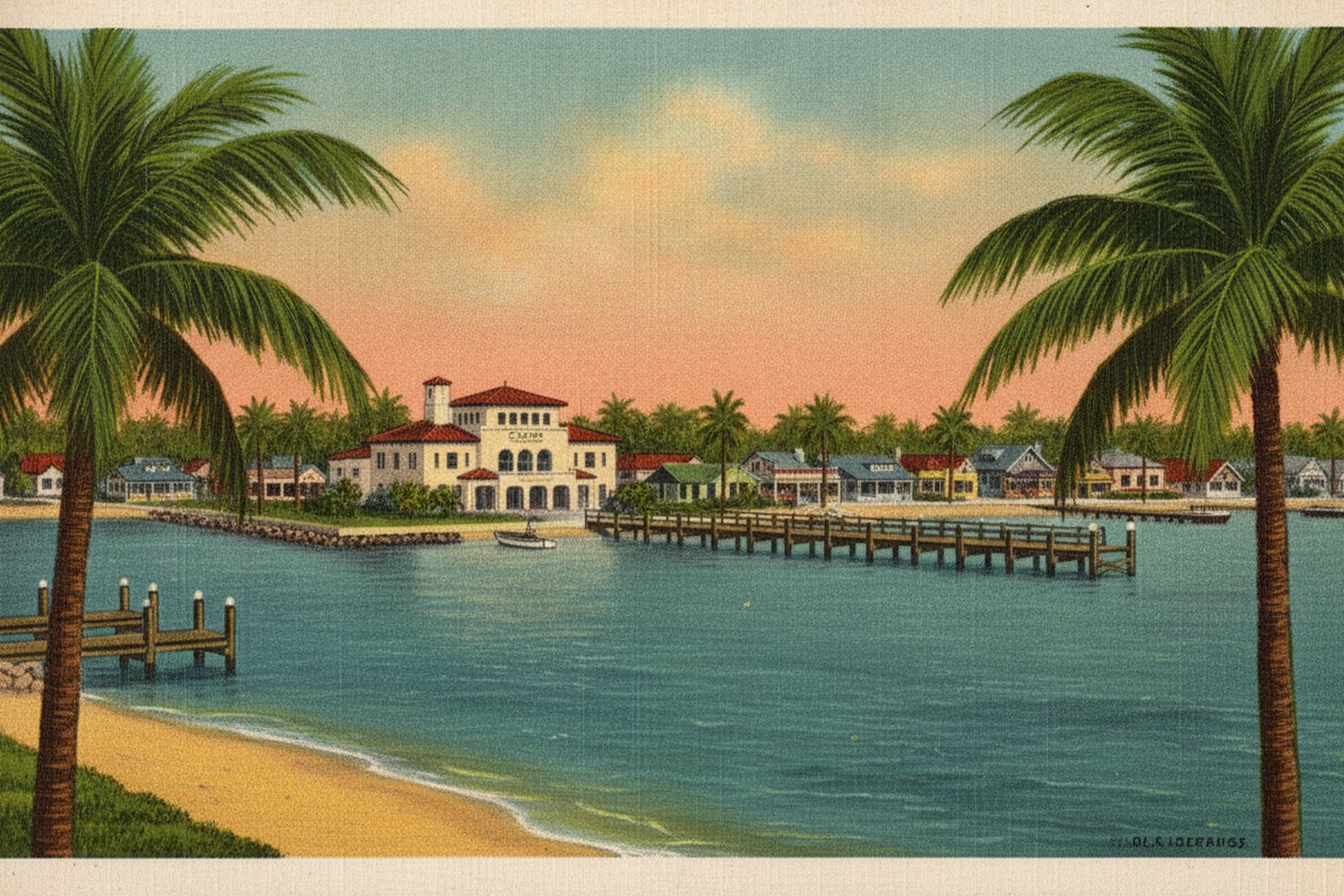
Not a St. Pete neighborhood — a separate little city on Boca Ciega Bay, with an arts-village main street and its own permitting, rental, and floodplain rules.
live data connecting
This band shows real market numbers — median sale price, days on market, active inventory — computed over Everlane’s own copy of the Stellar MLS data, with the computation time shown. Live numbers publish here as soon as the data feed is connected; until then we show you nothing rather than a made-up number.
Based on information from Stellar MLS® for the period shown with each statistic — median sale price and days on market: trailing 90 days; active listings: as of the computation time shown; price per square foot: trailing 12 months.
Built by Selenko, Everlane’s own studio automation — see how this site runs →
Start with the fact that surprises most people: Gulfport is not a St. Petersburg neighborhood. It’s a separate city — its own incorporated municipality in Pinellas County, bordering St. Petersburg, South Pasadena, and Boca Ciega Bay (Wikipedia dates the incorporation to 1910; accessed July 2026). It has its own mayor, city council, and city manager, its own building department and code of ordinances (City of Gulfport, accessed July 2026). At roughly 2.76 square miles of land, it’s small enough to cross on foot, and it wears its identity plainly: an arts-minded waterfront town that happens to sit inside the St. Pete metro, not a piece of it.
What the map doesn’t tell you is how much that boundary line does. Because Gulfport governs itself, the things that decide a purchase here — permits, business-tax receipts, rental and short-term-rental rules, floodplain administration — run through Gulfport’s rulebook, not St. Petersburg’s. A plan that works one street over on the St. Pete side can be a different plan, or a dead one, on this side of the line. That’s not a footnote; it’s the first thing to get right, and the short-term-rental map is where the rental piece gets read in full.
The center of gravity is Beach Boulevard, the waterfront main street: locally owned restaurants, waterfront bars, art galleries, and small shops running down to the bay and the municipal marina (City of Gulfport / Wikipedia, accessed July 2026). The arts character isn’t a slogan — it’s built into the calendar and the buildings. Downtown hosts a first-Friday Art Walk, the Catherine A. Hickman Theater stages a community-players season, and the Gulfport Casino Ballroom — a 1930 building with a 5,000-square-foot dance floor — runs dance events through the week (Wikipedia, accessed July 2026). The city’s own Arts Center and the Waterfront Redevelopment District anchor that identity officially (City of Gulfport, accessed July 2026).
Boca Ciega Bay is the other constant: a bay connected to the Gulf, an aquatic preserve since 1968, with mangrove shoreline and seagrass rather than an open-beach edge (Boca Ciega Bay record, accessed July 2026). The housing stock skews older and small-scale — cottages, bungalows, and mid-century block homes on compact lots — though that’s a place characterization to confirm per listing (MEDIUM), not a record I’d anchor an offer on. The trade for the walkable, low-rise charm is the same one the whole shoreline carries: older systems and a flood story that has to be read address by address, which the box below covers.
The honest answer renders from data, not from a guide that goes stale: the stat band on this page computes from our MLS pipeline (median sale price, days on market, active inventory) and refreshes continuously — if it shows no numbers yet, the pipeline hasn’t connected, and we’d rather show you nothing than a made-up figure. Gulfport’s small footprint means inventory can be thin and uneven month to month, so the deal-level read — what a specific block, house, flood zone, and rental question should cost — is a conversation, not a chart, and it’s free.
Because the boundary is the whole point of this chapter. Three places where “it’s a separate city” stops being trivia and starts costing or saving money:
None of that makes Gulfport harder to buy in — it makes it a place where knowing which city you’re actually in is the difference between a clean deal and an expensive surprise. That’s the per-address, per-city read we run before you offer, and it’s the free part.
These bands compute from closed sales in the Stellar MLS feed (trailing 12 months) the moment the data feed connects — honest ranges, never AVM point estimates, never made-up numbers. Until then this box stays empty on purpose: we render real data or nothing.
Gulfport sits low on Boca Ciega Bay, and the water is close to most of it: bayfront and low-lying interior blocks carry high-risk AE (and, on the open-water edge, coastal V) ratings where coverage is required and priced to the elevation certificate, while higher interior ground sits in the moderate/minimal zones — a per-address pattern read on the Pinellas County Flood Map Service (free, public), never assumed. One wrinkle that matters here: because Gulfport is its own city, its floodplain administration and permit path are the city's own, not St. Petersburg's — a distinction we confirm before, not after.
Flood data source: FEMA flood maps via the Pinellas County Flood Map Service (not MLS data) · verified July 8, 2026
Read the flood & insurance guide →Live Gulfport inventory renders here — straight from our copy of the Stellar MLS feed with full attribution, the moment the data feed connects. Until then: open the live search →
Zone by zone, carrier by carrier — how coverage on Boca Ciega Bay really gets priced after the 2024 storms.
Read onWhere Gulfport sits in the city's larger map — and which places are their own small towns, like this one.
Read onGulfport writes its own rental rules — separate from St. Pete's. Read the map of what's allowed where before you count on Airbnb income.
Read onTalk to the broker who wrote the chapter. Fifteen minutes, free, and the messy version of your situation is the right version to bring.
A free 30-minute consult, straight onto Serge’s calendar. Prefer to write first? use the contact page →